
VIDEO STORY
THE DOCUMENTARY FILM
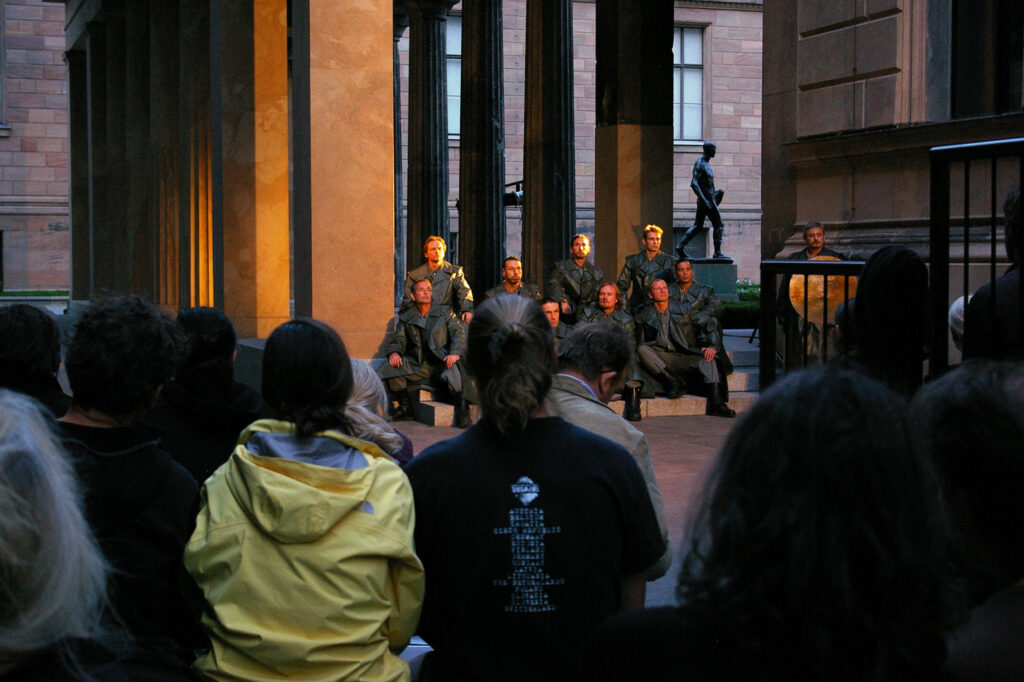
The final DOCUMENTARY FILM is a narrative documentary in which real prison characters disguise themselves and tell the story of Shakespeare’s play, but in reality they unmask themselves by analyzing the relationship between crime and the desire for affirmation and personal power. In practice, the film integrates the story of Macbeth, completing it with the three points of view. To achieve both objectives—the artistic one and the social process—we developed a valid and necessary PLAN for the three companies. The plan is simple because it will have to work in different environments, all challenging due to prison constraints, and limited by the minimal budget. FILMING and Post-producing the collected materials for the DOCUMENTARY FILM integrates the representation of the three companies’ stories, and by also using transitional material on the characters’ personalities, a kind of theatrical film—backstage reportage—on the group of participants; according to an innovative project that can integrate footage representing the theatrical development process and interviews with the inmates.
MACBETH - SINOPSYS
ACT ONE
The tragedy opens in a gloomy medieval Scotland, amidst an atmosphere of lightning and thunder; three witches (the Fatal Sisters, undoubtedly inspired by the Norns of Norse myth and the Fates/Moirai of Greco-Roman tradition) decide that their next meeting must take place in the presence of Macbeth.
In the following scene, a wounded sergeant reports to King Duncan of Scotland that his generals, Macbeth and Banquo, have just defeated the combined forces of Norway and Ireland, led by the rebel Macdonwald. Macbeth, the king’s kinsman, is praised for his courage and prowess in battle.
The scene changes: Macbeth and Banquo appear on the scene, returning to their castles, reflecting on the victory they have just achieved and on the “fair and foul” weather that characterizes the ambiguous and supernatural nature of the desolate, fog-filled moor they are crossing. The three witches, who have been waiting for them, appear and utter prophecies. Although Banquo challenges them first, they address Macbeth: the first greets him as “Macbeth, Lord of Glamis,” a title Macbeth already holds; the second as “Macbeth, Lord of Cawdor,” a title he does not yet possess; and the third as “Macbeth, the King.” Macbeth is stunned and silent, so Banquo once again attempts to confront them, intimidated by the appearance of the Fatal Sisters and the peculiar, mysterious circumstances of the moment. The witches then inform Banquo that he is the founder of a royal dynasty and vanish, leaving Macbeth and Banquo in doubt as to the true nature of that strange apparition.
The king then arrives and announces to Macbeth that he has been granted the title of Lord of Cawdor: the first prophecy is thus fulfilled, and Macbeth immediately begins to harbor ambitions of becoming king.
Macbeth writes to his wife (Lady Macbeth) about the three witches’ prophecies. When Duncan decides to stay at Macbeth’s castle in Inverness, Lady Macbeth hatches a plan to kill him and secure the throne of Scotland for her husband, and although Macbeth shows hesitation, wanting to retrace his steps and denying the ambitions expressed in the letter sent to his wife, she eventually convinces him.
ACT TWO
On the night of the visit, Lady Macbeth intoxicates the king’s guards, putting them into a deep sleep. Macbeth, with a well-known soliloquy that leads him to see a hallucination of a bloody dagger before him, leading him to the murder of his own king and cousin, sneaks into Duncan’s chambers and stabs him to death. Shocked by the act, he takes refuge with Lady Macbeth, who, however, is undaunted and recovers by leaving the two weapons used in the assassination near the sleeping bodies of the guards, smearing their faces, hands, and robes with the king’s blood.
In the morning, shortly after the arrival of MacDuff, a Scottish nobleman come to pay homage to the king, the murder is discovered. In a feigned fit of rage, Macbeth kills the guards before they can claim their innocence.
MacDuff is immediately suspicious of Macbeth’s conduct, but does not reveal his suspicions publicly. Fearing for his life, Duncan’s son, Malcolm, flees to England. On this basis, Macbeth, due to his kinship with Duncan, ascends the throne of Scotland.
Despite his success, Macbeth is uneasy about the prophecy that Banquo would become the founder of a dynasty of kings, fearing that he too will be dethroned. So he invites him to a royal banquet and learns that Banquo and his young son, Fleance, will be out riding that evening. Macbeth hires two assassins to kill Banquo and Fleance (a third assassin mysteriously appears in the park before the murder; some critics believe he may be the image and personification of the spirit of the Assassination). Banquo is then brutally slaughtered, but Fleance manages to escape. At the banquet, supposed to celebrate the king’s triumph, Macbeth is convinced he sees Banquo’s ghost sitting in his place, while the onlookers and Lady Macbeth herself see nothing. The rest of the guests are frightened by Macbeth’s fury towards an empty seat, until a desperate Lady Macbeth orders everyone to leave.
ACT THREE
Macbeth, now straddling the real and supernatural worlds, goes to the witches in search of certainty. When questioned, they summon spirits to answer: an armed head tells Macbeth, “Beware of MacDuff,” a bloody child tells him, “No one born of woman can harm you,” a crowned child tells him, “Macbeth will not be defeated until Birnam Wood moves toward Dunsinane.” Finally, a procession of eight spirits appears, symbolizing Banquo’s descendants, the sight of which fills Macbeth with despair.
A season of bloody persecution begins against all the Scottish lords the king deems suspect, and especially against MacDuff. A group of assassins is sent to his castle to kill him, but once there, the mercenaries do not find him, having gone to England to seek military aid against Macbeth and start a revolt. The assassins, however, slaughter MacDuff’s wife and children in a scene full of pathos and cruelty.
ACT FOUR
In England, MacDuff and Malcolm plan an invasion of Scotland. Macbeth, now identified as a tyrant, sees many barons deserting his side. Malcolm leads an army with MacDuff and Seyward, Earl of Northumbria, against Dunsinane Castle, a fortress associated with the Scottish throne where Macbeth resides. The soldiers, camped in Birnam Wood, are ordered to cut down the branches of the trees to disguise their numbers. This fulfills the witches’ third prophecy: by holding the branches high, countless soldiers resemble Birnam Wood advancing towards Dunsinane.
ACT FIVE
Lady Macbeth, deeply burdened by a growing moral burden, can no longer bear the weight of her crimes and begins to be tormented by visions and nightmares that disrupt her sleep: one of her ladies recounts and shows a doctor episodes of sleepwalking, which erupt into desperate crises in which the queen attempts to clean her hands of indelible bloodstains, confusing past and present and revealing all the murders she committed to conquer and maintain the throne. Upon hearing the news of his wife’s death and facing the advance of the rebel army, Macbeth delivers his famous soliloquy (“Tomorrow, and tomorrow, and tomorrow”), on the vain meaning of life and all the actions that punctuate it, vain, insignificant acts aimed at achieving goals that have no real value.
He then demands that weapons and armor be brought to him, ready to fight dearly in what he already feels is his final act.
The battle rages beneath the walls of Dunsinane, and young Seyward, MacDuff’s ally, dies at the hands of the tyrant, who then confronts MacDuff. Macbeth believes he has no reason to fear the rebel lord, because he cannot be harmed or killed by “anyone born of woman,” according to the witches’ prophecy. MacDuff, however, declares that he was “torn before his time from his mother’s womb,” and therefore was not truly “born” of woman. Macbeth, however, in the heat of battle, accepts this fate and shows not a single moment of weakness in his lucid madness. The two fight, and MacDuff beheads Macbeth, thus fulfilling the last of the prophecies.
Even though Malcolm, not Fleance, ascended the throne, the witches’ prophecy concerning Banquo was considered true by Shakespeare’s audience, who believed King James I to be a direct descendant of Banquo.